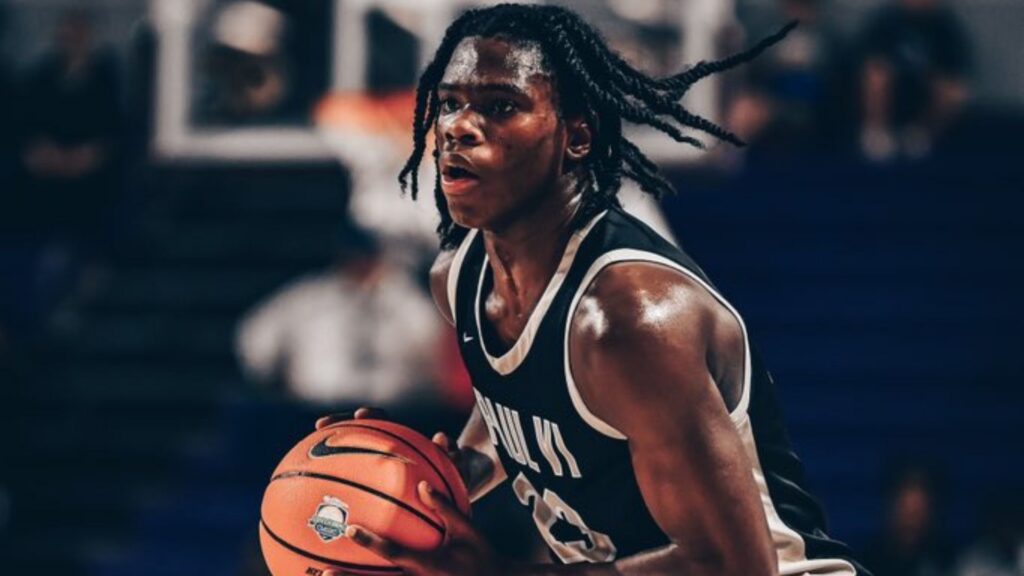
The hardest thing to teach a lead guard is pace. Jordan Smith Jr. already plays with it.
Jordan Smith Jr. falls into the second category.
At 6’3”, the guard out of Washington, D.C. isn’t the loudest presence on the floor. He doesn’t rely on moments to define his impact.
He controls them.
What Shows Up Early
There’s a certain steadiness to his game that becomes clear quickly.
Not in the highlights.
In the pacing.
The ability to read a possession before it develops. To recognize where the defense is leaning and respond without forcing the action.
That’s not something most players rely on at this stage.
Peach Jam Context
Playing with Team Takeover on the EYBL circuit, Smith entered Peach Jam with expectations that matched his reputation.
The team didn’t reach the Final Four.
But the evaluation didn’t change.
Because what translates at that level isn’t just outcome.
It’s control.
What Actually Stands Out
Smith’s game is built on timing.
When to push.
When to slow.
When to take over.
When to move the ball.
He doesn’t rush decisions.
And in high-pressure environments, that separation becomes clear.
The Misread
In a setting like Peach Jam, it’s easy to focus on production.
Who scored the most.
Who had the biggest moment.
But guards who control tempo tend to get evaluated differently.
Because their impact isn’t always loud.
It’s consistent.
Why Coaches Are Paying Attention
Programs like Syracuse, Georgetown, UConn, Maryland, and Michigan have all been in the mix.
Not just because of what Smith can do offensively.
But because of how he manages a game.
That’s what carries to the next level.
Beyond the Surface
Smith has a game that could live in the highlight cycle.
But that’s not where his value comes from.
It comes from composure.
From decision-making.
From a style of play that doesn’t break down under pressure.
Why This Matters
The hardest role to evaluate in youth basketball is the lead guard.
Because the question isn’t just skill.
It’s control.
And control is what tends to translate.
Closing
Smith doesn’t need the game to speed up for him.
He plays at a pace that forces everything else to adjust.
And in a system that’s often driven by urgency, that kind of presence tends to last.
Editor’s Note (2026)
Since this evaluation, Smith has continued to build on his reputation as one of the most composed guards in his class, deciding to join John Calapari an the Arkansa Razorbacks.