In today’s basketball landscape, visibility often becomes part of evaluation. Brandon McCoy Jr. spent the summer challenging that idea.
Brandon McCoy Jr. leaned into the second approach.
For most of the spring, the five-star guard out of California stayed largely outside the usual grassroots conversation. While other players in the 2026 class moved through the travel circuit building visibility, McCoy remained mostly out of sight.
That created questions quickly.
Because in today’s environment, absence often gets treated like decline.
The Return
McCoy arrived at Peach Jam with Arizona Unity after months away from the public spotlight.
The response was immediate.
In a matchup against fellow elite prospect Christian Collins, he finished with 21 points in front of a baseline filled with college coaches and NBA scouts.
But the production wasn’t really the story.
It was the comfort.
The pace he played with.
The composure.
The ability to settle into high-level competition without looking rushed after a long layoff.
That stood out quickly.
What Changed
Earlier in the summer, McCoy participated in USA Basketball training camp, where some evaluators questioned how sharp he looked returning to live competition.
That conversation didn’t last long.
“The spring was quiet for him,” one high-major assistant coach told ESC during Peach Jam. “But you watch him for a few possessions and remember exactly who he is.”
What Actually Stands Out
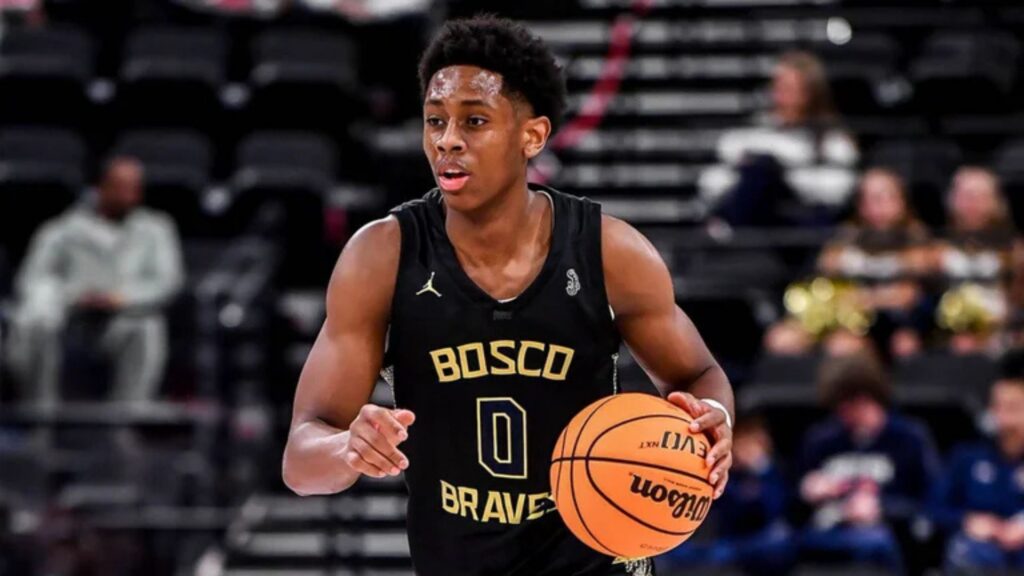
At 6’4”, McCoy plays with the kind of pace coaches look for in lead guards.
Not rushed.
Not reactive.
Controlled.
He changes tempo naturally and rarely forces action. In high-pressure environments, that separation becomes easier to see because so many guards start speeding up.
McCoy usually does the opposite.
The Visibility Question
Grassroots basketball increasingly rewards constant exposure.
Players are expected to stay visible year-round, and long stretches away from the circuit often create speculation around momentum and development.
McCoy’s summer offered a reminder that visibility and growth are not always the same thing.
Not every important stretch happens publicly.
Sometimes stepping away creates space for development that constant performance environments don’t allow.
The Recruitment Picture
Programs across the country continued prioritizing McCoy throughout the summer.
Duke, Arizona, Louisville, Houston, Alabama, Arkansas, Michigan State, and North Carolina were all heavily involved in his recruitment at the time. Jon Scheyer and members of Duke’s staff were seen multiple times during Arizona Unity’s Peach Jam run, reinforcing how important the evaluation remained despite the quieter spring.
Why This Matters
Youth basketball often rewards visibility first.
But long-term projection usually depends on something else.
Timing.
Decision-making.
Feel.
The ability to perform without needing constant momentum around you.
McCoy’s return mattered because it showed he never needed to chase the conversation in the first place.
Closing
Some players rely on visibility to stay in the conversation.
Others step back, develop quietly, and return when they’re ready.
McCoy’s summer felt closer to the second.
Editor’s Note (2026)
Since this evaluation, McCoy has continued his senior-year development as one of the most closely watched guards in the country, with his recruitment remaining a priority for several national programs as he prepares for the next level.