There’s a certain kind of player that immediately changes the temperature of a game.
Not because they’re the loudest.
Not because they score the most.
Not because every possession ends up on social media.
But because everything around them starts settling into rhythm once the ball is in their hands.
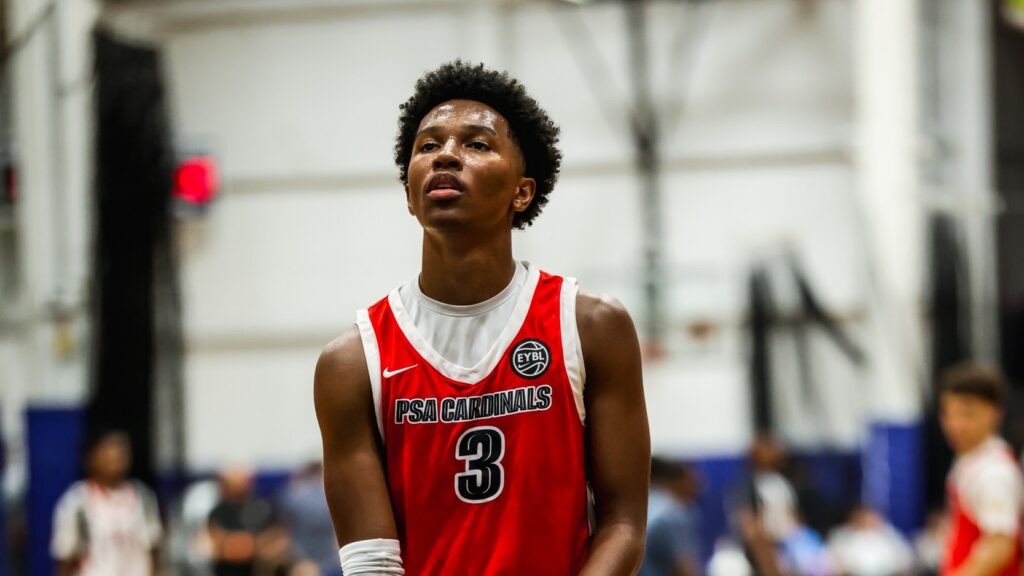
That’s what stands out watching Corey Burnett.
The PSA Cardinals guard doesn’t play rushed, even when everyone around him is. And in today’s youth basketball environment, where pace, visibility, and pressure continue accelerating earlier and earlier, that trait matters more than people realize.
Some players speed the game up.
The impactful ones understand when to slow it down.
At a stage where many young guards rely almost entirely on athletic bursts and reaction-based play, Burnett already shows signs of something more difficult to teach: feel.
Not flashy “feel.”
Functional feel.
The ability to process movement.
Read positioning.
Manipulate timing.
Recognize angles before they fully develop.
You see it in transition.
You see it in half-court spacing.
You see it in the way defenders shift once he gets downhill.
The production matters, of course. But what consistently shows up watching Burnett is composure.
That’s the through line.
Multiple evaluators across different events and circuits have pointed to many of the same traits:
• floor vision
• pace
• decision-making
• poise
• control
• winning plays
Not just scoring.
That distinction is important.
In a basketball culture increasingly driven by clips, reactions, and instant visibility, some of the most translatable qualities still tend to reveal themselves more quietly.
Burnett’s game reflects that.
There’s patience to how he navigates space. He plays off two feet in traffic. He changes speeds naturally instead of forcing tempo. He understands when to create for others and when to become aggressive himself. The shot-making continues developing, but the larger signal is how consistently he stays connected to the flow of the game.
That’s usually what separates guards who can produce from guards who can organize.
And organization matters.
Especially as the game becomes more crowded, faster, and increasingly dependent on decision-making under pressure.
Beyond basketball, Burnett’s discipline off the floor continues reinforcing the same themes visible within his game. Balancing high-level basketball while maintaining strong academic standards at Dwight-Englewood speaks to structure, consistency, and maturity, qualities that often reveal themselves long before recruiting conversations fully arrive.
That’s part of why projection in youth basketball can be complicated.
The loudest traits are not always the ones that translate longest.
Athleticism changes.
Physical advantages evolve.
Timelines shift.
But feel, pace, processing, and decision-making often age differently.
That’s why players like Burnett become interesting to watch over time.
Not because anyone can predict exactly where the journey leads.
But because certain foundational traits continue holding value no matter how much the game changes around them.
And right now, in a youth basketball ecosystem that rarely slows down, Corey Burnett already understands something many players spend years trying to learn:
Control still matters.
FINAL BUZZER
Corey Burnett’s game is rooted less in noise and more in understanding. The pace. The reads. The composure. The ability to make difficult decisions look calm. In an era increasingly shaped by acceleration, that kind of control continues standing out.
And more importantly, it continues translating.